


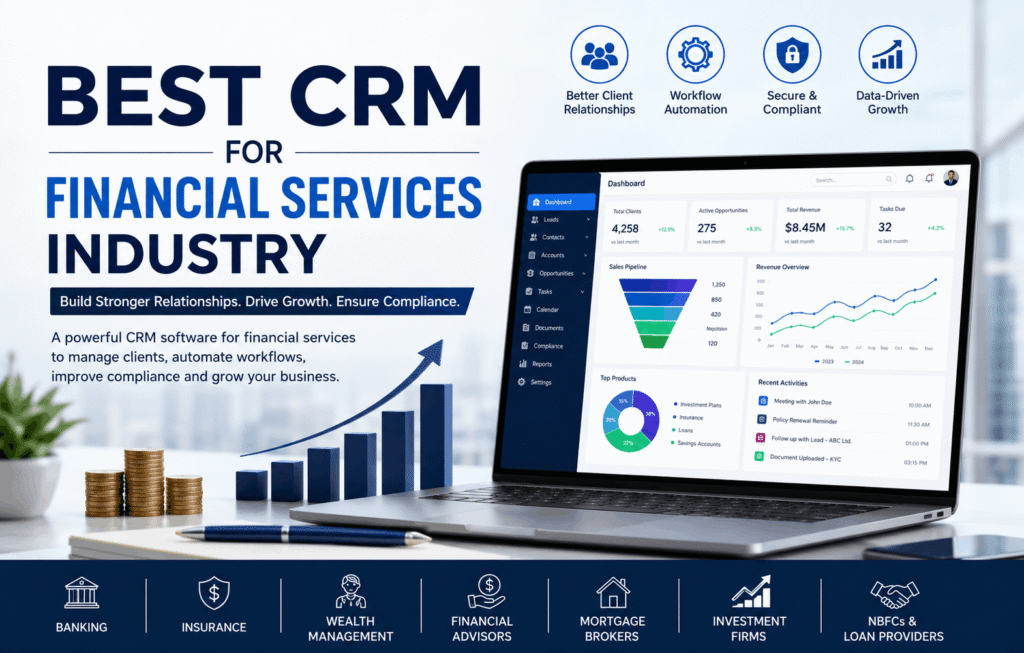


Financial institutions rely on strong client relationships, secure data management, and efficient workflows to stay competitive. A CRM for Financial Services Industry helps banks, insurance companies, wealth management firms, financial advisors, mortgage providers, and NBFCs centralize customer information, automate daily operations, improve compliance, and deliver personalized customer experiences. Choosing the Best CRM for the financial services industry enables organizations to increase productivity, strengthen customer loyalty, and drive long-term business growth.
The financial services industry is undergoing a rapid digital transformation. Customers today expect faster responses, personalized financial advice, seamless communication, and secure digital experiences across every touchpoint. Whether they are opening a new account, applying for a loan, purchasing insurance, or managing investments, clients expect financial institutions to understand their needs and deliver exceptional service.
Unfortunately, many organizations still rely on spreadsheets, disconnected databases, manual follow-ups, and outdated customer management processes. These inefficiencies often lead to missed sales opportunities, delayed customer responses, compliance risks, and poor client experiences.
This is where a CRM Software for Financial Services becomes an essential business tool. A dedicated Financial Services CRM helps organizations centralize customer information, automate repetitive tasks, manage leads effectively, and build stronger relationships throughout the customer lifecycle.
Table of Contents
What is CRM for Financial Services Industry?
A CRM for Financial Services Industry is a specialized customer relationship management platform built specifically to help financial organizations manage customer interactions, sales pipelines, client communications, documents, compliance requirements, and business workflows from a single centralized system.
Instead of storing customer information across multiple spreadsheets, emails, and disconnected software applications, a Financial CRM Solution creates a single source of truth where every customer interaction is securely stored and easily accessible.
A modern Customer Relationship Management for Financial Services platform helps businesses:
- Manage leads from multiple sources
- Track every customer interaction
- Maintain complete client profiles
- Schedule meetings and reminders
- Automate follow-ups
- Store financial documents securely
- Generate business reports
- Improve customer retention
- Ensure regulatory compliance
By giving employees a complete 360-degree view of every client, financial institutions can provide faster, more personalized service while improving internal collaboration.
Generic CRM vs. Financial Services CRM
Although many businesses use generic CRM software, financial organizations require industry-specific functionality that addresses complex operational and compliance needs.
| Generic CRM | Financial Services CRM |
|---|---|
| Basic contact management | Complete client lifecycle management |
| Simple sales tracking | Financial planning and advisory workflows |
| Limited compliance support | Regulatory compliance management |
| Standard document storage | Secure financial document management |
| General reporting | Industry-specific financial analytics |
| Basic automation | Advanced financial services automation |
A dedicated Financial Services CRM Platform goes far beyond contact management by integrating sales, service, compliance, communication, and customer engagement into one unified solution.
Why Financial Institutions Need a Dedicated CRM Software
Customer expectations continue to rise while financial regulations become increasingly complex. Managing hundreds or thousands of client relationships manually is no longer practical.
Implementing a CRM Software for Financial Services enables organizations to improve productivity while delivering exceptional customer experiences.
1. Centralized Customer Information
Financial organizations interact with customers through multiple channels, including phone calls, emails, websites, branch offices, WhatsApp, and social media.
Without a centralized system, customer information becomes fragmented.
A Financial Client Management Software stores:
- Contact details
- Financial goals
- Investment history
- Insurance policies
- Loan applications
- Documents
- Meeting notes
- Communication history
Having all this information in one place allows advisors to provide personalized recommendations much faster.
2. Better Lead Management
Lead generation is only the first step. Converting prospects into long-term customers requires consistent follow-ups.
An advanced Lead Management for Financial Services solution helps businesses:
- Capture leads automatically
- Assign leads to advisors
- Track lead status
- Schedule reminders
- Automate follow-up emails
- Monitor conversion rates
This prevents missed opportunities while improving sales performance.
3. Personalized Customer Experiences
Today’s customers expect financial institutions to understand their unique financial goals.
A specialized Client Relationship Management for Finance system enables advisors to personalize every interaction using customer data, previous conversations, investment preferences, and financial history.
This results in:
- Better customer engagement
- Stronger relationships
- Increased trust
- Higher customer satisfaction
4. Improved Regulatory Compliance
Compliance is one of the biggest challenges in the financial sector.
A Financial CRM Solution helps organizations maintain accurate records while ensuring that customer information is securely stored and easily retrievable during audits.
Key compliance benefits include:
- Secure data storage
- Activity logs
- User permissions
- Document tracking
- Audit trails
- Consent management
These features reduce operational risks while simplifying regulatory reporting.
5. Faster Customer Service
Customers no longer want to repeat their information every time they contact a financial institution.
With a Customer Relationship Management for Financial Services platform, support teams can instantly access:
- Previous conversations
- Account history
- Submitted documents
- Active products
- Pending requests
This significantly reduces response times while improving customer satisfaction.
6. Increased Productivity Through Automation
Manual administrative work consumes valuable employee time.
Modern Financial Services Automation allows organizations to automate repetitive tasks such as:
- Appointment reminders
- Email follow-ups
- Lead assignments
- Task creation
- Customer onboarding
- Document approvals
Automation enables employees to focus on delivering valuable financial advice rather than routine administrative tasks.
Key Features to Look for in the Best CRM for Financial Services Industry
Choosing the Best CRM for Financial Services Industry requires more than comparing pricing. The ideal solution should support every stage of the customer journey while improving operational efficiency.
Here are the essential features every organization should look for.
Lead and Opportunity Management
A powerful CRM Software for Financial Services should simplify lead generation and conversion.
Features include:
- Lead capture from multiple channels
- Automatic lead assignment
- Opportunity tracking
- Sales pipeline management
- Follow-up reminders
- Lead scoring
Effective lead management increases conversion rates while improving advisor productivity.
360-Degree Customer View
One of the biggest advantages of a Financial Services CRM is providing employees with a complete customer profile.
This includes:
- Personal information
- Communication history
- Financial products
- Investment portfolios
- Loan applications
- Insurance policies
- Meeting records
- Service requests
Having a complete customer view helps advisors deliver highly personalized financial services.
Workflow Automation
A CRM with Workflow Automation reduces manual effort by automatically managing routine business processes.
Automation can streamline:
- Lead nurturing
- Customer onboarding
- Policy renewals
- Investment reviews
- Appointment scheduling
- Internal approvals
- Escalations
This not only saves time but also minimizes human errors.
Secure Document Management
Financial organizations handle highly confidential documents every day.
A CRM with Document Management allows businesses to securely store:
- Identity documents
- Contracts
- Loan agreements
- Insurance policies
- Investment records
- Financial statements
Centralized document storage improves accessibility while maintaining strict security standards.
AI-Powered Customer Insights
Artificial intelligence is transforming customer relationship management.
An AI CRM for Financial Services analyzes customer behavior and business data to help organizations:
- Predict customer needs
- Identify sales opportunities
- Detect inactive clients
- Recommend financial products
- Forecast revenue
These insights enable smarter decision-making and more personalized customer engagement.
Mobile CRM
Financial advisors often work outside the office.
A cloud-based Financial Services CRM Platform with mobile access allows teams to:
- Update customer records
- Schedule meetings
- Access documents
- Manage leads
- Respond to customer inquiries
from anywhere, improving flexibility and responsiveness.
Reports and Analytics
Business decisions should always be data-driven.
The Best CRM for Financial Services Industry should provide real-time dashboards that measure:
- Lead conversion
- Revenue growth
- Advisor performance
- Customer retention
- Sales pipeline
- Service quality
- Marketing ROI
These insights help managers optimize operations and improve business performance.
Benefits of CRM Software for Financial Services
Investing in a specialized CRM Software for Financial Services offers far more than improved customer management. It enables financial organizations to build stronger relationships, increase operational efficiency, and drive sustainable growth.
Some of the biggest advantages include:
- Improved customer experience through personalized communication
- Better lead management and higher conversion rates
- Increased customer retention and loyalty
- Faster response times and improved service quality
- Streamlined financial services automation
- Secure client data management
- Enhanced regulatory compliance
- Improved collaboration across departments
- Smarter business decisions through real-time reporting
- Higher employee productivity with automated workflows
Organizations that implement the right CRM for Financial Advisors, CRM for Wealth Management, Banking CRM Software, or Insurance CRM Software are better positioned to deliver exceptional client experiences while adapting to the rapidly evolving financial landscape.
Industries That Can Benefit from a Financial Services CRM
A modern CRM for Financial Services Industry is designed to support organizations of all sizes, from small financial advisory firms to large banking institutions. By centralizing customer data, automating workflows, and improving communication, a CRM Software for Financial Services helps businesses build stronger client relationships while increasing operational efficiency.
Below are some of the industries that can benefit the most from implementing a Financial Services CRM Platform.
Banks
Banks manage thousands of customer interactions every day, ranging from account openings and loan applications to investment consultations and customer support. A dedicated Banking CRM Software enables banks to maintain a complete customer profile, track interactions, automate follow-ups, and provide personalized financial recommendations.
With a centralized CRM, banking teams can also identify cross-selling opportunities for savings accounts, credit cards, loans, and investment products, improving both customer satisfaction and revenue.
Insurance Agencies
Insurance providers need to manage customer policies, claims, renewals, and ongoing communication. A specialized Insurance CRM Software helps agents organize customer information, schedule policy renewal reminders, automate follow-up messages, and maintain secure documentation.
By reducing manual work, insurance agencies can focus more on customer service and relationship building while minimizing missed renewal opportunities.
Wealth Management Firms
For firms offering investment and wealth management services, maintaining long-term client relationships is critical. A CRM for Wealth Management allows advisors to monitor investment portfolios, record client goals, schedule portfolio reviews, and deliver personalized financial advice.
A centralized Financial CRM Solution ensures every interaction is documented, enabling advisors to offer proactive recommendations based on each client’s financial objectives.
Financial Advisors
Independent advisors often manage multiple clients simultaneously. A CRM for Financial Advisors simplifies appointment scheduling, document management, task tracking, and communication history, allowing advisors to spend more time helping clients rather than managing administrative work.
Using Financial Advisor CRM Software, advisors can automate reminders for investment reviews, tax planning sessions, retirement planning meetings, and annual financial assessments.
Investment Firms
Investment companies handle a large volume of sensitive customer information, financial transactions, and portfolio management activities. An Investment Management CRM provides secure client records, document management, communication tracking, and workflow automation.
It also helps firms monitor investor engagement, identify upselling opportunities, and improve client retention through personalized communication.
Mortgage Brokers and Loan Providers
Mortgage companies and lending institutions manage complex application processes involving multiple documents, approvals, and customer interactions. A CRM for Mortgage Brokers or Loan Management CRM helps streamline every stage of the lending process.
Features like automated document requests, application tracking, status updates, and approval workflows reduce processing time while improving customer satisfaction.
NBFCs and Credit Unions
Non-Banking Financial Companies (NBFCs) and credit unions serve a diverse customer base with various financial products. A Customer Relationship Management for Financial Services platform enables these organizations to manage customer inquiries, automate lead nurturing, track loan applications, and monitor customer engagement from a single dashboard.
This improves operational efficiency while delivering a consistent customer experience across every interaction.
How CRM Improves Client Relationship Management in Finance
Building trust is essential in the financial services sector. Customers expect personalized advice, timely communication, and seamless service throughout their financial journey. A robust Client Relationship Management for Finance solution helps organizations meet these expectations by providing a complete view of every client relationship.
Personalized Customer Communication
Every client has unique financial goals, risk tolerance, and investment preferences. A Financial Services CRM stores comprehensive customer profiles, allowing advisors to tailor recommendations and communication based on individual needs.
Whether it’s sending investment updates, policy renewal reminders, or personalized financial planning tips, a CRM helps create more meaningful customer interactions.
Automated Follow-Ups
Missed follow-ups can result in lost business opportunities. A CRM with Workflow Automation ensures no customer inquiry or sales opportunity is overlooked.
Businesses can automate:
- Welcome emails
- Appointment confirmations
- Investment review reminders
- Loan status updates
- Insurance renewal notifications
- Customer satisfaction surveys
Automation not only improves response times but also strengthens customer relationships through consistent engagement.
Customer Segmentation
Not every customer requires the same products or communication strategy. A Financial Client Management Software enables businesses to segment customers based on factors such as:
- Income level
- Investment preferences
- Loan history
- Insurance products
- Geographic location
- Financial goals
- Customer lifetime value
This segmentation allows organizations to run highly targeted marketing campaigns and provide more relevant financial solutions.
Complete Client History
One of the biggest advantages of a Customer Relationship Management for Financial Services platform is maintaining a complete interaction history.
Employees can instantly access:
- Previous meetings
- Phone calls
- Emails
- Financial products purchased
- Service requests
- Documents shared
- Support tickets
- Advisor notes
Having this information readily available improves service quality and helps clients feel valued.
Omnichannel Customer Engagement
Today’s customers interact with financial institutions through multiple communication channels. A Cloud CRM for Financial Services consolidates communication from email, phone, WhatsApp, SMS, live chat, and web forms into one platform.
This ensures customers receive consistent service regardless of how they choose to communicate.
Stronger Customer Retention
Acquiring a new customer is often more expensive than retaining an existing one. A Financial Services CRM Platform helps businesses build long-term relationships through proactive communication, personalized service, and timely follow-ups.
Happy customers are more likely to remain loyal, refer new clients, and purchase additional financial products over time.
Essential CRM Integrations for Financial Companies
The effectiveness of a CRM Software for Financial Services increases significantly when it integrates with other business applications. These integrations reduce manual data entry, improve collaboration, and streamline business operations.
Email Integration
Connecting the CRM with email platforms enables automatic logging of customer conversations, making communication history easily accessible for every team member.
SMS and WhatsApp Integration
Customers appreciate quick updates regarding appointments, loan approvals, policy renewals, and payment reminders. SMS and WhatsApp integrations allow organizations to communicate instantly while maintaining a complete interaction history.
Accounting Software
Integration with accounting platforms ensures financial records remain synchronized across departments. Advisors can access billing information, invoices, and payment history directly from the CRM.
Payment Gateway Integration
Payment gateway integration simplifies invoice payments, premium collections, loan repayments, and service fee processing while improving customer convenience.
Document Storage
A CRM with Document Management integrates with secure cloud storage platforms, allowing businesses to organize contracts, financial statements, identity documents, and compliance records efficiently.
Digital Signature Solutions
Digital signatures accelerate customer onboarding and document approvals by eliminating paperwork and reducing turnaround times.
Banking APIs
Financial organizations can integrate CRM systems with banking APIs to provide real-time account updates, transaction history, and customer financial information, creating a seamless customer experience.
Marketing Automation Platforms
Marketing automation tools help financial organizations nurture leads through personalized email campaigns, newsletters, educational content, and targeted promotions.
Combined with Financial Services Automation, these integrations significantly improve lead conversion and customer engagement.
How to Choose the Best CRM for Financial Services Industry
Selecting the Best CRM for Financial Services Industry requires evaluating more than just software features. The ideal solution should align with your business objectives, regulatory requirements, and future growth plans.
Consider the following factors before making a decision.
Industry-Specific Features
Choose a CRM that is specifically designed for financial organizations rather than a generic customer management system. Industry-focused solutions provide features such as compliance tracking, secure document management, financial workflows, and client lifecycle management.
Ease of Use
An intuitive interface encourages user adoption and reduces training time. Employees should be able to manage leads, customer records, and daily tasks without extensive technical knowledge.
Customization
Every financial organization operates differently. A flexible Financial CRM Solution should allow businesses to customize modules, workflows, dashboards, fields, and reports based on their operational requirements.
Security and Compliance
Since financial institutions handle highly sensitive customer information, security should be a top priority. Look for features such as:
- Role-based access control
- Data encryption
- Audit logs
- Secure backups
- Multi-factor authentication
- Compliance support
Scalability
As your organization grows, your CRM should grow with you. A scalable Cloud CRM for Financial Services supports increasing customer volumes, additional users, and expanding business operations without compromising performance.
Integration Capabilities
Ensure the CRM integrates seamlessly with your existing software ecosystem, including accounting tools, email platforms, marketing software, payment gateways, and communication applications.
Reporting and Analytics
Real-time dashboards and advanced analytics help management monitor sales performance, customer engagement, advisor productivity, and revenue growth, enabling informed business decisions.
Why Optsoft CRM is the Right Choice for Financial Services Businesses
Choosing the right technology partner is just as important as selecting the right CRM. Optsoft CRM offers a comprehensive, customizable, and scalable solution designed to address the unique challenges of financial service providers.
Whether you’re a bank, insurance agency, NBFC, wealth management firm, mortgage company, or financial advisory business, Optsoft CRM provides the tools needed to manage customer relationships more effectively.
Some of the key advantages include:
- Industry-specific customization for financial workflows
- Advanced Lead Management for Financial Services
- Complete 360-degree customer profiles
- Intelligent CRM with Workflow Automation
- Secure CRM with Document Management
- Cloud-based accessibility for remote teams
- Automated reminders and follow-ups
- Powerful reporting and business analytics
- Role-based security and user permissions
- Easy integration with third-party applications
- Mobile accessibility for advisors on the go
- Scalable architecture that grows with your business
By combining automation, security, and customization, Optsoft CRM helps financial organizations improve operational efficiency, enhance customer satisfaction, and achieve sustainable business growth. It is an ideal CRM Software for Financial Services for businesses looking to streamline operations and build lasting client relationships.
Frequently Asked Questions
What is the best CRM for the financial services industry?
The best CRM for the financial services industry is one that offers customer lifecycle management, workflow automation, compliance support, document management, reporting, and secure client data storage. It should also be customizable to meet the specific needs of banks, insurance agencies, wealth managers, and financial advisors.
Why do financial advisors need CRM software?
A CRM for Financial Advisors helps manage client relationships, schedule appointments, automate follow-ups, store financial documents, and provide personalized financial advice based on complete customer profiles.
Can CRM software improve regulatory compliance?
Yes. A dedicated Financial Services CRM maintains secure records, activity logs, document history, and audit trails, making it easier for organizations to comply with industry regulations and internal governance policies.
Is cloud CRM secure for financial companies?
Modern Cloud CRM for Financial Services solutions use advanced security measures such as encryption, role-based access controls, secure backups, and multi-factor authentication to protect sensitive customer information.
What features should a financial services CRM include?
Essential features include lead management, workflow automation, document management, customer 360° view, reporting, AI-powered insights, compliance tools, mobile access, integrations, and customer communication management.
Conclusion
The financial services industry is built on trust, responsiveness, and long-term client relationships. As customer expectations continue to evolve, relying on manual processes and disconnected systems is no longer sustainable.
Implementing the Best CRM for Financial Services Industry empowers organizations to centralize customer data, automate routine tasks, strengthen compliance, and deliver highly personalized experiences across every stage of the customer journey.
Whether you’re looking for a CRM for Financial Services Industry, CRM Software for Financial Services, CRM for Wealth Management, Financial Advisor CRM Software, Banking CRM Software, or Insurance CRM Software, choosing a scalable and customizable platform can significantly improve efficiency and business growth.
With its industry-specific capabilities, workflow automation, secure document management, and flexible customization, Optsoft CRM provides a reliable solution for modern financial organizations. By investing in the right Financial Services CRM Platform, businesses can build stronger customer relationships, improve productivity, and stay competitive in an increasingly digital financial landscape.